
understanding
the categories &
criteria for inclusion
This map highlights the people and organizations building, funding, and supporting innovation, starting in Alabama.
Each organization fits under one primary category and subcategory based on its core role in the ecosystem. Here’s how we define them!
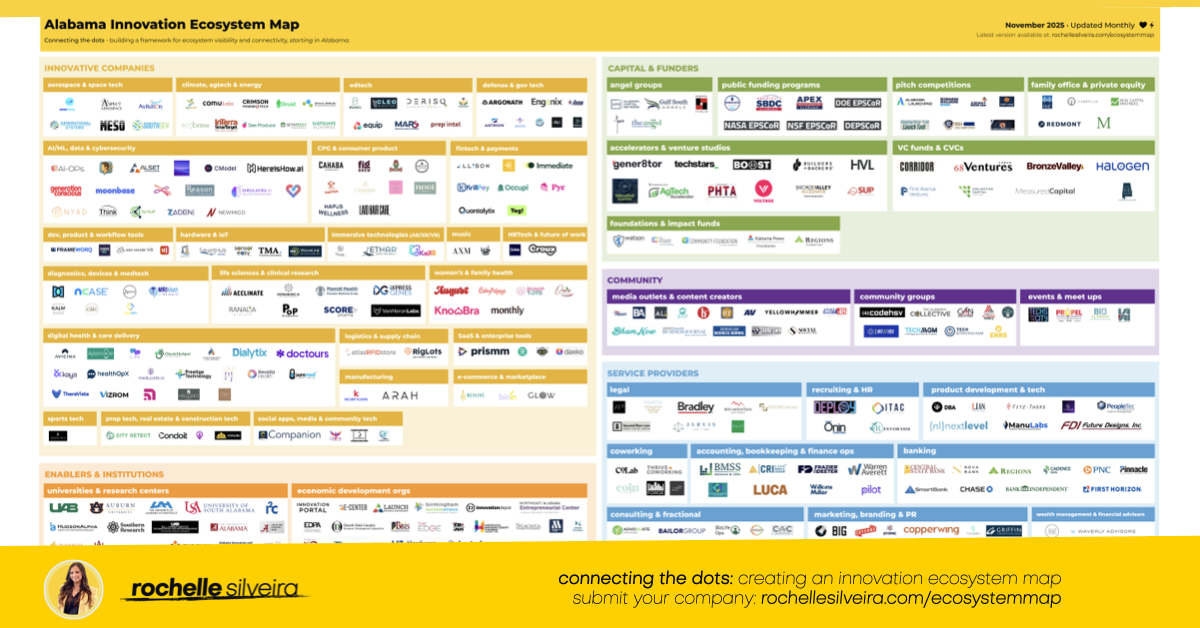
Select below to navigate to the section and see the criteria for each category listed on the map
Note: listings are for informational purposes only and do not imply endorsement.
🟡 Innovative Companies by Sector
The companies building Alabama’s future.
This section maps innovative businesses across every major industry — from AI and biotech to aerospace, fintech, defense tech, and advanced manufacturing. Each company appears once, under its primary sector, so you can quickly see who's building what across the state. This category is for product and platform companies: startups, scaleups, and innovation-driven businesses whose core value lives in what they've built — not in services they deliver to others.
Who they are: Companies building innovative products, platforms, or technologies across diverse industries.
Criteria: Must be headquartered in Alabama or have significant operations or a founding team presence in the state. Must derive core value from a product, platform, or proprietary technology — not primarily from services delivery or government contracting. Each company appears once, under its primary market or technology vertical.
Purpose: Showcase Alabama’s innovative companies & startups landscape by vertical focus — making it easier to discover who’s building what.
Sectors include:
Aerospace & SpaceTech: Companies developing technologies for aviation, defense aerospace, satellites, launch, space systems, or supporting tools and services for space missions.
AI/ML, Data & Cybersecurity: Companies whose core value is built on artificial intelligence, machine learning, advanced analytics, data infrastructure, or cybersecurity products. The product or technology must be the primary offering — companies that offer cybersecurity as one service line among many do not qualify here.
Climate, AgTech & Energy: Companies creating solutions for climate resilience, sustainability, agriculture, food systems, carbon and emissions reduction, or next-generation energy production and management.
CPG / Consumer Products: Brands designing and selling physical products directly to consumers, including food & beverage, beauty, apparel, home goods, and wellness products.
Defense & GovTech: Companies building technology products and platforms for defense, national security, intelligence, public safety, or government agencies. Core value must be in the product itself — not in engineering services, IT staffing, or systems integration for the DoD.
Dev, Product & Workflow Tools: Companies building tools that help teams design, build, deploy, or manage software, products, and work—such as project management, developer tools, workflow automation, and planning platforms.
E-commerce & Marketplace: Companies operating digital marketplaces or platforms that connect buyers and sellers, power online retail, or streamline digital transactions for physical or digital goods and services.
EdTech: Companies building technology for learning, training, assessment, or education delivery across K-12, higher ed, workforce development, or lifelong learning.
Fintech & Payments: Companies innovating in financial services — payments, banking, lending, financial infrastructure, wealth and financial wellness, or tools that move, manage, or optimize money.
Gaming, Music & Entertainment: Companies creating games, interactive experiences, creator tools, music or media platforms, or technologies that power entertainment and fan engagement.
Hardware/IoT: Companies building connected devices, sensors, robotics, or physical products where hardware and embedded technology are core to the solution.
Digital Health & Care Delivery: Companies using software or data to improve how care is delivered — virtual care, care coordination, population health, benefits navigation, mental health platforms, and patient engagement tools.
Diagnostics, Devices & MedTech: Companies developing medical devices, diagnostics, wearables, or clinical tools that support detection, monitoring, or treatment of health conditions.
Life Sciences & Clinical Research: Biotech, therapeutics, life-science tools, and platforms supporting clinical research, genomics, drug development, or biological discovery.
Women’s & Family Health: Companies focused on women’s health, maternal and reproductive health, fertility, period and pelvic health, parenting, or family-centered care and products.
HRTech & Future of Work: Companies building tools for hiring, staffing, workforce management, employee experience, upskilling, or new models of work and talent.
Immersive Technologies (AR/XR/VR): Companies using augmented, mixed, or virtual reality — and spatial computing — to power training, education, entertainment, industrial, or consumer experiences.
Insurtech: Companies reinventing insurance products, distribution, underwriting, claims, or risk management through technology and data.
Logistics & Supply Chain: Companies improving how goods and materials move—covering freight, trucking, warehousing, inventory, tracking, or supply chain visibility and optimization.
Manufacturing: Companies innovating in how physical goods are designed, produced, or assembled—including advanced manufacturing, materials, automation, and industrial processes.
PropTech, Real Estate, ConstructionTech: Companies building technology for real estate, construction, infrastructure, or property operations—from development and construction to leasing, amenities, and building management.
SaaS & Enterprise Tools: Software-as-a-service platforms and enterprise tools that help organizations run their operations—spanning functions like CRM, back office, analytics, collaboration, or vertical-specific business software.
Social Apps, Media & Community Tech: Consumer apps and platforms that help people connect, share content, build community, or discover experiences—both online and in real life.
Social Impact & Nonprofit Tech: Companies and platforms with a primary focus on social impact—supporting nonprofits, philanthropy, civic engagement, equity, or community outcomes through technology.
SportsTech: Companies building products for athletes, teams, coaches, leagues, or fans — covering performance, analytics, recruiting, training, events, or fan engagement.
Travel, Hospitality & Tourism: Companies innovating in travel, dining, lodging, events, and local experiences—including tools for hospitality operators and platforms that help people discover or enjoy places.
Web3, Blockchain & Crypto: Companies using blockchain, distributed ledgers, digital assets, or Web3 infrastructure to enable new financial, ownership, or coordination models.
🟢 Capital & Funders
Who is backing Alabama’s founders.
This section brings together the full spectrum of capital sources supporting Alabama’s innovation economy: accelerators, angel groups, VC funds, corporate investors, pitch competitions, family offices, public funding programs, and impact foundations. It shows founders where funding comes from — and helps companies discover opportunities across the state.
Who they are: Organizations and distinct funding programs that provide access or deploy capital to innovative companies, startups, and small businesses.
Capital may take many forms, including:
Equity investments
Convertible instruments
Grants and matching funds
Tax incentives and credits
Co-investment vehicles (e.g., SSBCI)
Structured venture-building programs
Criteria: Must meet at least one of the following:
Headquartered in Alabama
Actively backing or investing in Alabama-based companies within the past three years
Administering a public or statewide funding mechanism materially impacting Alabama startups
Programs may appear as separate entries when they:
Have distinct eligibility criteria
Maintain their own landing page and/or application process
Deploy capital directly (grants, tax credits, matching funds, co-investment, etc.)
Represent a capital pathway founders must navigate independently
Parent organizations remain listed once, and program entries should reference their parent organization in the description.
Purpose: Identify who is fueling Alabama’s innovation economy through investment, grants, incentives, and structured venture creation.
Subcategories:
Accelerators & Venture Studios – Programs combining capital, mentorship, and structured growth, including venture-building models.
Angel Groups – Networks of individual investors funding early-stage ventures.
Family Office & Private Equity – Institutional or family-managed capital targeting growth-stage or control investments.
Foundations & Impact Funds – Mission-driven funds investing in social, economic, or community impact ventures.
Pitch Competitions – Events awarding startup funding or non-dilutive prizes.
Public Funding Programs – Government or state-supported capital mechanisms, including grants, loans, matching funds, tax incentives, and SSBCI-backed programs.
VC Funds & CVCs – Professional venture capital firms and corporate investment arms.
🟠 Enablers & Institutions
The organizations powering innovation behind the scenes.
These are the institutions, economic development groups, universities, research centers, and strategic initiatives that help founders build, launch, and scale. They create infrastructure, support commercialization, convene industry partners, and drive long-term ecosystem development across Alabama.
Who they are: Universities, research centers, nonprofits, public entities, and ecosystem programs that build innovation infrastructure and long-term capacity. If the organization or program builds ecosystem capacity (vs. primarily deploying capital), it belongs here.
This includes:
Talent pipeline programs
University innovation initiatives
Statewide innovation networks
Research commercialization efforts
Founder support and ecosystem-building infrastructure
Criteria: Must meet at least one of the following:
Based in Alabama
Actively supporting Alabama’s innovation ecosystem through programs, research, infrastructure, or ecosystem coordination
Operating a distinct statewide or regional innovation initiative that builds long-term capacity
Programs may appear as separate entries when they:
Operate as a recognizable, structured initiative
Have distinct participation criteria
Provide measurable ecosystem infrastructure (talent, commercialization, inclusion, coordination, etc.)
Function as a navigable entry point into the ecosystem
Parent organizations remain listed once, and program entries should reference the parent organization when applicable.
Purpose: Highlight the foundational organizations and initiatives driving talent development, research, commercialization, inclusion, and long-term ecosystem growth across Alabama.
Subcategories:
Economic Development Orgs – Chambers and regional organizations focused on economic growth, job creation, business attraction, and ecosystem coordination.
Industry Clusters – Sector-specific networks and anchor institutions driving innovation in key industries (biotech, defense, aerospace, automotive, etc.).
Innovation & Technology Hubs – Organizations that operate and activate places where innovation happens. Place-based entities that run programming, convene founders and partners, and create community inside research parks, innovation districts, incubators, and tech campuses.
Innovation District Developers – Developers and landholding entities that design, finance, or master-plan research parks, mixed-use innovation districts, and tech campuses that house startups, research, and innovation-focused organizations.
Nonprofit Innovation & Entrepreneurship Support – 501(c)(3) or 501(c)(6) organizations advancing entrepreneurship, workforce development, inclusion, or founder support through programs, education, or community initiatives.
Universities & Research Centers – Academic institutions and research organizations conducting R&D, commercialization, translational research, or entrepreneurship education.
🔵 Service Providers
The partners helping companies grow.
This section lists the professional services organizations that support Alabama's founders and innovation companies — accounting firms, legal partners, marketing agencies, coworking spaces, product studios, recruiters, and financial advisors. These aren't companies building products; they're the specialists founders rely on to operate, hire, and scale.
Who they are: Businesses offering specialized expertise or services to founders, startups, and innovation-driven companies.
Criteria: Must be operating in Alabama and actively serving founders, small businesses, or innovation-driven companies within the state. General professional services firms not serving the innovation ecosystem are excluded.
Purpose: Make it easier for companies to find trusted partners and professional resources locally.
Subcategories:
Accounting – Firms specializing in bookkeeping, audit, and finance for startups and growing companies.
Banking – Financial institutions supporting founders with accounts, credit, or treasury services.
Consulting – Strategic advisory firms across operations, growth, or innovation.
Coworking – Shared workspaces or innovation hubs open to the public.
Legal – Attorneys and firms supporting business formation, IP, contracts, and fundraising.
Marketing & Branding – Agencies focused on communications, design, or growth marketing.
Product Development & Tech – Engineering, design, and dev shops supporting MVPs and scaling products.
Recruiting & HR – Talent firms and HR specialists helping companies hire and grow teams.
Wealth Management & Financial Advisors – Wealth managers, accountants, and advisors supporting founders and investors.
🟣 Community
The people, groups, and stories connecting the ecosystem.
This section is home to community groups, meetups, events, awards, and media outlets that bring Alabama’s innovation landscape to life. From grassroots founder circles to statewide conferences, creator-led storytelling, and local meetups, these communities strengthen relationships and make the ecosystem more accessible, visible, and connected.
Who they are: The builders, storytellers, and connectors driving Alabama’s culture of innovation.
Criteria: Must be Alabama-founded, based, or recurring in the state and focused on connecting, celebrating, or storytelling around innovation and entrepreneurship happening in the state.
Purpose: Recognize the grassroots efforts that strengthen community, visibility, and collaboration.
Subcategories:
Awards – Recognitions celebrating innovation, founders, startups, and ecosystem leaders.
Events & Meetups – Recurring or one-time gatherings for learning and networking.
Community Groups – Member-led or volunteer-driven collectives (e.g., tech councils, founder networks).
Media Outlets & Content Creators – Publications, podcasts, influencers, and news platforms covering innovation stories in Alabama.
Bring this framework to your community
This framework and taxonomy are original work, designed to create visibility, navigation, and connectivity within innovation ecosystems.
Cities and organizations interested in launching this model in their market are invited to explore collaboration, licensing, or partnership opportunities.
If your city, region, or organization is exploring ecosystem visibility, let’s talk.